2nd International Congress of Forum Herbulot, Munich, Germany, 13-14.iii.2003
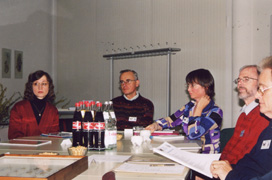
From left to right: Anthony C. Galsworthy, Stefan Schmidt, Hans Löbel, George Balogh (behind),
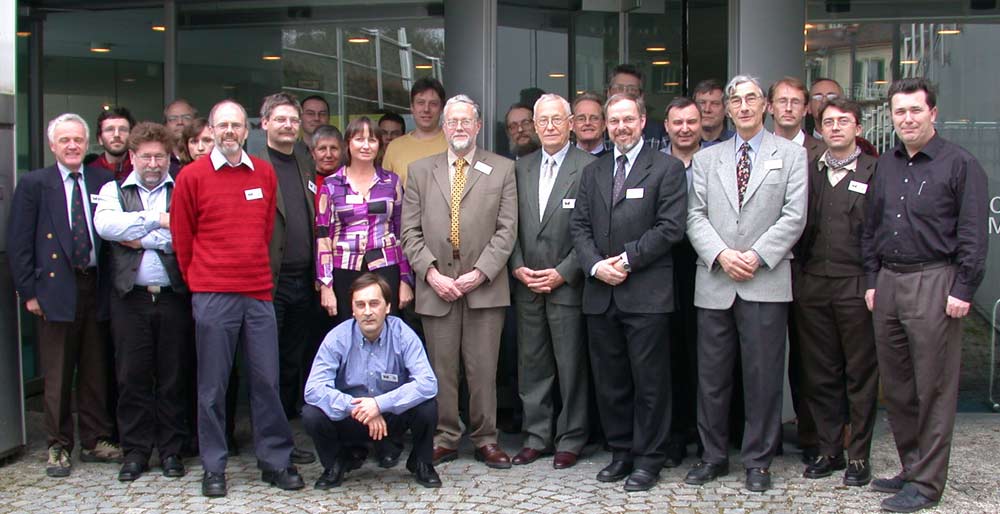
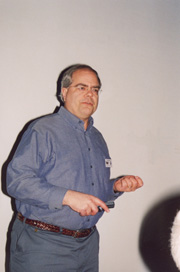
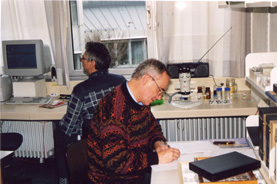
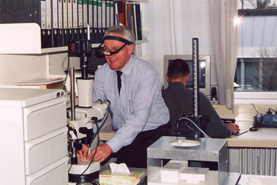
From left to right: Anthony C. Galsworthy, Stefan Schmidt, Hans Löbel, George Balogh (behind), Olga Schmidt, Peter McQuillan, Alexander Schintlmeister, Sven Erlacher (behind), Marie-Thérèse Ebode, Cathy Young, Vladimir Mironov (in front), Andreas H. Segerer, Jeremy D. Holloway, Jaan Viidalepp, Philippe Darge, Henry Barlow, Axel Hausmann, Evgeny Beljaev (behind, partially hidden), Bernd Müller, Martin Baehr, Manfred Sommerer, Martin Krüger, Janusz Wojtusiak (behind, partially hidden), Robert Trusch, Gerhard Haszprunar.
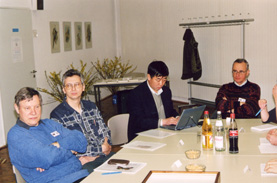
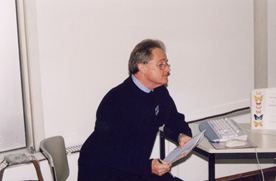
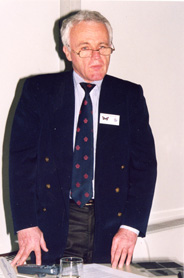
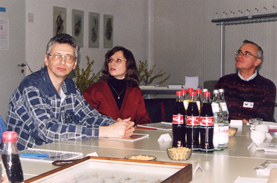
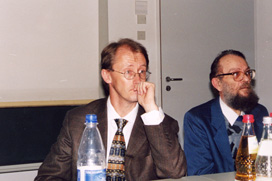
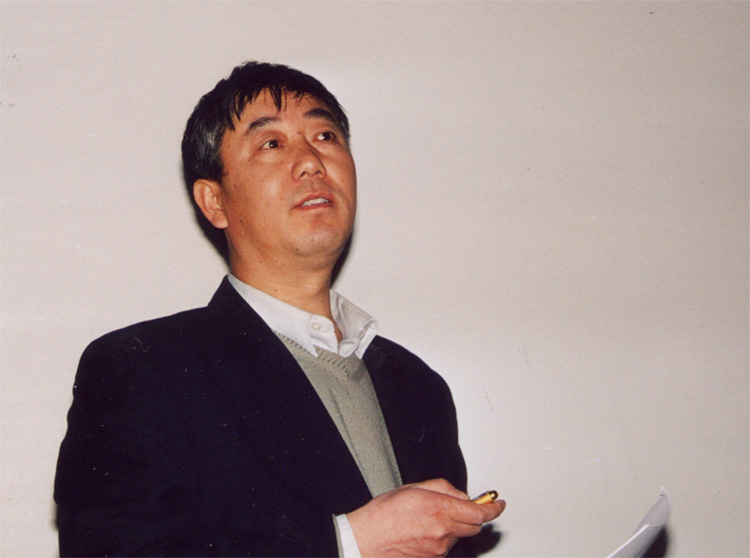
Participants
Barlow, Henry (Malaysia)
Beljaev, Evgeny (Russia)
Buchsbaum, Ulf (Germany)
Darge, Philippe (France)
Dayong, Xue (China)
Ebode, Marie-Thérèse (France)
Erlacher, Sven (Germany)
Galsworthy, Anthony C. (England)
Haszprunar, Gerhard (Germany)
Hausmann, Axel (Germany)
Holloway, Jeremy D. (England)
Hongxiang, Han (China)
Krüger, Martin (South Africa)
Löbel, Hans (Germany)
McQuillan, Peter (Tasmania)
Miller, Michael (Germany)
Mironov, Vladimir (Russia)
Müller, Bernd (Germany)
Scalercio, Stefano (Italy)
Schintlmeister, Alexander (Germany)
Schmidt, Olga (Germany)
Schmidt, Stefan (Germany)
Segerer, Andreas H. (Germany)
Sommerer, Manfred (Germany)
Trusch, Robert (Germany)
Viidalepp, Jaan (Estland)
Wojtusiak, Janusz (Poland)
Young, Cathy (Tasmania)
Zilli, Alberto (Italy)
Proceedings
1. The chairman outlined once more the aims of the FORUM HERBULOT (see www.herbulot.de). The participants welcomed the research initiative and stressed the need for, and advantages of, the opportunities offered for close scientific cooperation among geometrid experts. Access to the rich Coll. Herbulot with its manifold historical assets was greatly appreciated. Following a brief address from Claude Herbulot (in absentia presented by Philippe Darge) the participants expressed their respect for the achievements of the founder of the collection and patron of the Forum. The use of internet-based tools with a view to linking collection data with existing or planned databases in order to improve the availability of relevant data was discussed (Henry Barlow; A. Hausmann).
2. The seminar session highlighted promising possibilities for systematic research.
The first four talks (J.D. Holloway, M. Krüger, C. Young, P. McQuillan) presented and summarised the actual stage of research concerning the phylogeny of Geometridae on subfamily and tribe level as resulting from different data sets, such as larval morphology (M. Krüger, C. Young), adult morphology (J.D. Holloway, M. Krüger), host-plant relationships (J.D. Holloway, P. McQuillan), zoogeographical patterns (M. Krüger, J.D. Holloway) and molecular analysis (C. Young, P. McQuillan). The study of skeleto-muscular anatomy of genitalia as additional information was encouraged (E. Beljaev).
The southern hemisphere Archiearinae had been revised and separated from Holarctic groups (P. McQuillan). Although some morphological characters and host-plant relationships suggest that the subfamilies Archiearinae and Oenochrominae (s.str.), and the tribes Diptychini and Nacophorini (Ennominae) are phylogenetically ‚old‘ groups (J. D. Holloway, M. Krüger), Larentiinae and Sterrhinae appear as the most basal groups using molecular methods (sequence analysis of four nuclear and mitochondrial genes; Abraham et al. 2001; C. Young, P. McQuillan, A. Hausmann, S. Erlacher). Refinement of molecular methods as valuable tools for evolutionary and systematic studies had been postulated by the Forum Herbulot 2001 (Hausmann & Trusch 2001) in order to supplement the morphological and ecological data sets. Now, on the basis of the paper by Abraham et al. (2001), promising results have been obtained by the two ‚molecular‘ groups actually working on Geometridae (C. Young/P. McQuillan; A. Hausmann/S. Erlacher/M. Miller). After discussion of all the findings, closer coordination and cooperation was agreed upon, and working plans were established, in order to focus future common research on a better understanding of the basic phylogeny of Geometridae.
Research on Eupitheciini constituted another theme of the meeting. Extention to research on a global scale (as recommended by Forum Herbulot 2001: Hausmann & Trusch 2001) is needed to fill existing gaps in our knowledge (e.g. Eupitheciini in Africa in relation to Asia and other regions). Cooperation was improved regarding Chinese (T. Galsworthy; V. Mironov, X. Dayong), and initiated for neotropical Eupitheciini (G. Balogh, J. Wojtusiak). New agenda for cooperation dating back to Forum Herbulot 2001 concerning the exploration of neotropical Geometridae were established (G. Balogh; A. Hausmann; J. Wojtusiak).
An interesting zoogeographical analysis of Australian carabids was presented (M. Baehr) and compared with similar findings for Lepidoptera. Gondwana distributions, drift on tectonic plates and colonisation were discussed with respect to some taxa from Africa, Australia, and the Indo-Pacific region (M. Krüger, J.D. Holloway, P. McQuillan). Speciation and variation of several taxonomically ‚difficult‘ groups of Indo-Pacific Geometridae were presented for discussion (X. Dayong; O. Schmidt; M. Sommerer; J. Viidalepp).
3. A proposal to continue the FORUM HERBULOT in Hobart, Tasmania late 2005 or early 2006 (organisation: P. McQuillan) was welcomed.
4. Participants expressed their thanks to the organizers and sponsors of the FORUM HERBULOT 2003.
Munich, 15.3.2003
Dr. A. Hausmann (ZSM, Munich, D), Dr. J. Holloway (NHM, London, U.K.), Dr. M. Krüger (Transvaal Mus., Pretoria, S.A.), Prof. Dr. P. McQuillan (Univ. Hobart, Tasmania, AUS), Manfred Sommerer (Munich, D)
Abraham, D., Ryrholm, N., Wittzell, H., Holloway, J.D., Scoble, M.J. & C. Löfstedt (2001): Molecular Phylogeny of the Subfamilies in Geometridae (Geometroidea: Lepidoptera). – Mol. Phylo. Evol. 20 (1): 65-77.
Hausmann, A. & R. Trusch (ed.) (2001c): Proceedings of the FORUM HERBULOT 2001. – Spixiana 24 (3): 193-202.
Programs
Thursday, 13.3.2003
14.00: Opening address
Prof. Dr. G. Haszprunar, director of the ZSM
14.10: Introduction
Dr. A. Hausmann, ZSM, Munich
14.20: Address of the guest of honour Claude Herbulot
Dr. Philippe Darge in absentia of Dr. Claude Herbulot, Paris
14.30-17.10: Seminar session
(times are indicated approximately, lectures should not exceed 10‘, discussion 5-15‘)
14.30: Dr. Jeremy D. Holloway, The Natural History Museum, London
Feeding relationships of supposed Gondwanaland Geometridae (preliminary title)
14.55: Dr. Martin Krüger, Transvaal Museum, Pretoria
Out of Africa repeated? On the tribal composition of southern Ennominae and the origin of Geometridae
15.15: Cathy Young, School of Geography and Env.Studies, University of Tasmania, Hobarth
The Place of the Australian Nacophorini in the Geometridae
15.35: Prof. Dr. Peter McQuillan, School of Geography and Env.Studies, University of Tasmania, Hobarth
The Foodplant relationships of the Australian Geometridae
15.55-16.20 coffee break
16.20: Henry Barlow, Kuala Lumpur
The moths of Borneo online
16.45: Dr. Jaan Viidalepp, Zool.-Bot. Inst., Tartu
Speciation or variation between moths from Malai peninsula and Indonesia (Borneo)?
17.10-17.40 coffee break
17.40-19.00: Informal part I (short reports, news and informations)
Australian Geometridae and Zoogeography
17.40: Prof. Dr. Peter McQuillan, School of Geography and Env.Studies, University of Tasmania, Hobarth
The Identity of the Australian Archiearinae
17.55: Olga Schmidt, ZSM, Munich
Some results of taxonomic research on larentiine moths (Lepidoptera: Geometridae) from the Australasian region
18.10: Dr. Martin Baehr, ZSM, Munich
Australia’s subantarctic Tropics – a contradiction?
Indopacific Geometridae and Zoogeography
18.25: Anthony C. Galsworthy, London
Work on the Eupitheciini of East and South Asia, with particular reference to the Eupithecia of China
18.35: Manfred Sommerer, Munich
On the south-east Asian species of the genus Photoscotosia
18.45: Dr. Evgeny Beljaev, Inst. of Biol. and Soil Sci., Far Eastern Branch of Russ. Acad.Sci., Vladivostok, RUS
Phylogenetic significance of skeleton-muscular anatomy of the genitalia in Geometridae
19.05: Prof. Dr. Janusz Wojtusiak, Jagiellonian University, Kraków, Poland
The species of the neotropical genus Trocherateina (Larentiinae)
Friday, 14.3.2003
9.00-12.00: Informal part (II) and visit to the collections
9.00: Dr. Xue Dayong & Hongxiang Han, Institute of Zoology, Chinese Academy of Sciences, Beijing
New Geometridae from the Indopacific region
9.25: George Balogh, Portage, U.S.A.
On the Eupithecia linariata group
9.40: Dr. A. Hausmann, ZSM, München, Germany
GBIF-D: A new project for Geometridae type inventorying
9.50: Visit to the molecular laboratory:
10.10-11.30: discussion on molecular phylogeny
Visit to the collections with free discussions on various topics
- Place, date, agenda, participants
- Report on FH 2003
12.25: Bavarian lunch at the premises of the ZSM
Closing