Zoogeography Workshop 2001, International Meeting of Experts on "Distribution Patterns of East European Geometridae"
Names of the participants on the Zoogeography Workshop 2001 (from left to right): S. Beshkov, V. A. Lukhtanov, Gy. Laszlo, V. Mironov, A. Malkiewic, J. Buszko , J. Viidalepp, D. Stüning, M. Sommerer, A. Hausmann, I. Kostjuk, A. Segerer, R. Trusch, W. Eckweiler, B. Müller. Photo: Ulf Buchsbaum.
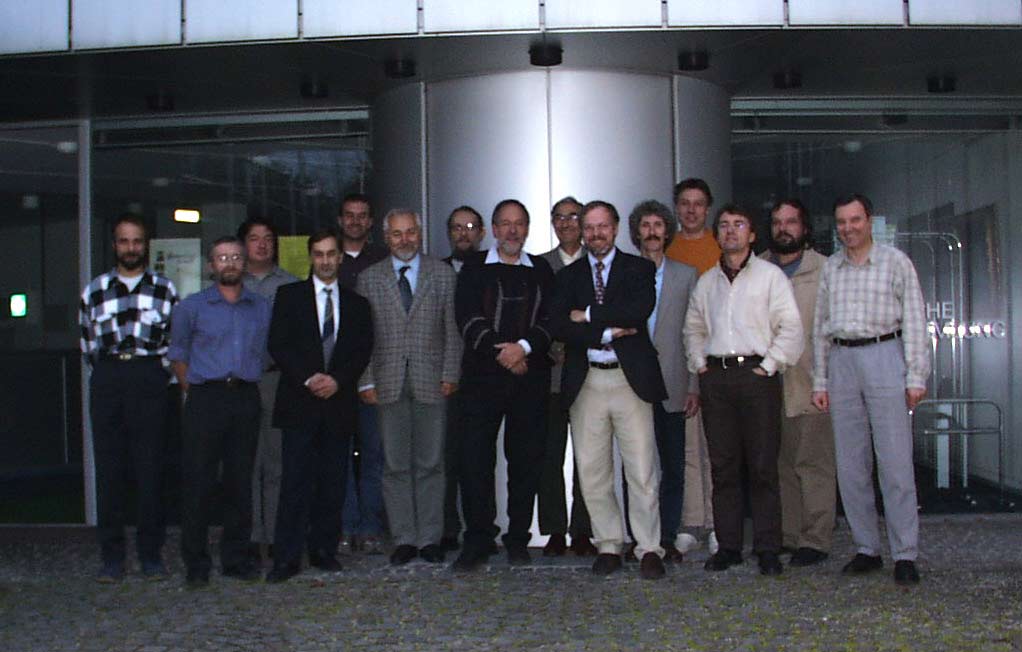
Names of the participants on the Zoogeography Workshop 2001 (from left to right): S. Beshkov, V. A. Lukhtanov, Gy. Laszlo, V. Mironov, A. Malkiewic, J. Buszko , J. Viidalepp, D. Stüning, M. Sommerer, A. Hausmann, I. Kostjuk, A. Segerer, R. Trusch, W. Eckweiler, B. Müller. Photo: Ulf Buchsbaum.
Participants
Beshkov, Stoyan (Bulgaria)
Buchsbaum, Ulf (Germany)
Buszko, Jaroslaw (Poland)
Eckweiler, Wolfgang (Germany)
Erlacher, Sven (Germany)
Gelbrecht, Jörg (Germany)
Haszprunar, Gerhard (Germany)
Hausmann, Axel (Germany)
Kostjuk, Igor (Ukraine)
Laszlo, Gyulai (Hungary)
Lukhtanov, V. (Russia)
Malkiewicz, A. (Poland)
Mironov, Vladimir (Russia)
Müller, Bernd (Germany)
Pöll, Norbert (Austria)
Segerer, Andreas H. (Germany)
Sommerer, Manfred (Germany)
Stanescu, M. (Romania)
Stüning, Dieter (Germany)
Trusch, Robert (Germany)
Viidalepp, Jaan, (Estonia)
Proceedings
Proceedings
1. Aims of the Zoogeography Workshop as outlined by the chairman were agreed upon by the participants. The need for closer scientific cooperation among geometrid researchers was expressed.
2. The seminar session highlighted promising possibilities for zoogeographic research on Western Palearctic Geometridae. It became evident that right now, with comprehensive faunistic results from modern and efficient monitoring projects from southern and eastern European countries (e.g. Ukraine, IK, Romania, MS, or Bulgaria, SB), it is possible to come to valuable zoogeographic conclusions. The results of JB and AM on population dynamics and colonisation strategies correspond well with similar results of VM concerning the genus Eupithecia. Antropogenous influences on distribution patterns have been discussed and are retained as important not only by man’s influences on the habitat (e.g. gravel and sand pits in Poland, JB & AM) but also by artificial displacement (Neozoa). The latter is suggested for the European Russian occurrence of Eupithecia repentina (VM). The importance of proper taxonomy for zoogeography was underlined by GL presenting the example of Agriopis aurantiaria. Interesting zoogeographic aspects of the Altai mountains as the eastern border of the western Palaearctic region were presented by VL. Most important was the discussion on a valuable and uniform system of terms for distribution patterns (JV). The discussion was prolonged on the second day of the workshop. It was agreed upon, that such a system (that may be used also in the book series ‘The Geometrid Moths of Europe’) should (1) reflect recent distribution, (2) be concise, using short and not too detailed terms and (3) not be based on too many different terms. A draft for a terminology of recent distribution types has been distributed as ‘home work’, asking all participants to give their comments.
3. Concrete cooperations were agreed upon concerning molecular research on the genus Timandra (JV, AM, AH, IK), on larval morphology (AM, SB, JG, BM), on museology and inventorying of taxonomic and zoogeographic basis data (AH, DS, VM, IK, MS).
4. A proposal to continue the Zoogeography Workshop in 2-years-intervals was welcomed. Date, topics and place of the next meeting remain to be established. For publication of the proceedings and abstracts of the Zoogeography Workshop 2001 it was agreed, to use the internet facility of the research initiative ‘Forum Herbulot’ at the ZSM. This web-page was accepted by all participants also as a platform to continue coordination and cooperation between researchers and specialists.
5. Participants expressed their thanks to the organizers and sponsors of the Zoogeography Workshop 2001.
Munich, 13.3.2001
Dr. A. hausmann (ZSM)
Programs
5.11.2001
13.20: Opening address and Introduction A. Hausmann, ZSM, chairman
13.40: Opening lecture
J. Buszko (University of Torun, Poland) & A. Malkiewicz (Inst. Zool. University of Wroclaw, Poland) On the significance of gravel and sand pits for spreading eastern (steppe) Geometridae in Poland
14.00-14.15 coffee break
14.15-16.20: Seminar session (with coffee, cakes and beverages)
J. Viidalepp (Zool.-Bot. Inst. Tartu, Estonia) Distribution areas, geoelements and faunistical complexes: some problems in East European fauna
V. Mironov (Zool. Inst. Acad. Sci. St. Petersburg, Russia) Eastern Palaearctic Eupithecia species in Europe.
Gy. Laszlo (Budapest, Hungary) Taxonomic studies on the genera Agriopis Hübner, [1825] 1816 and Erannis Hübner, [1825] 1816 (Lepidoptera, Geometridae).
M. Stanescu (Nat. Museum Nat. Hist. Bucharest, Romania) [lecture not presented orally] The present state of the knowledge of the the Geometridae fauna of Romania.
S. Beshkov (National Museum of Natural History Sofia, Bulgaria) New informations on distribution and ecology of Bulgarian Geometridae
I. Kostjuk (Zool. Mus. University of Kiew, Ukraine) State of research on Ukranian Geometridae and little known species from this territory.
V. A. Lukhtanov (University of St. Petersburg, Russia) Biogeography of the butterflies of Altai.
16.20-16.50 break
16.50-18.00: News and informations
- publications, articles in press, new literature
- running projects
- research initiative Forum Herbulot
- contacts and support of specialists, scientists and students, expeditions, cooperations, etc.
- date and venue of the next Zoogeography Workshop
18.00: Dinner at a nearby restaurant (with further discussions)
6.11.2001
8.00-19.00: Visit to the collections, Informal discussions (on the base of the very extensive East European, south-western Asian and central Asian material of the ZSM). Discussion on terminology of distribution patterns.
12.00: Bavarian lunch at the premises of the ZSM
7.11.2001
8.00-12.00: Visit to the collections, Informal discussions (on the base of the very extensive East European, south-western Asian and central Asian material of the ZSM). Presentation of research initiative Forum Herbulot, discussion on coordination of research focussed on Geometridae.
12.00: Bavarian lunch at the premises of the ZSM
Closing